


The Power To Do
Public Impact Research
Since a harmful algal bloom forced the city of Toledo to issue a “Do Not Drink” water advisory in 2014, UToledo has been working to protect water quality and the health of Lake Erie for the half million people in the region who depend on it for drinking water. This five-part series details UToledo’s water quality research efforts over the past decade.
Water Crisis in Toledo: 10 Years Later
20+
Faculty researchers currently participating on Water Task Force
150+
Sponsored or externally sponsored water quality projects tackled by Water Task Force
since 2014
$50M
External funding supporting water quality projects since 2014
Ten Years After Water Crisis, UToledo Remains Committed to Protecting Region’s Drinking Water
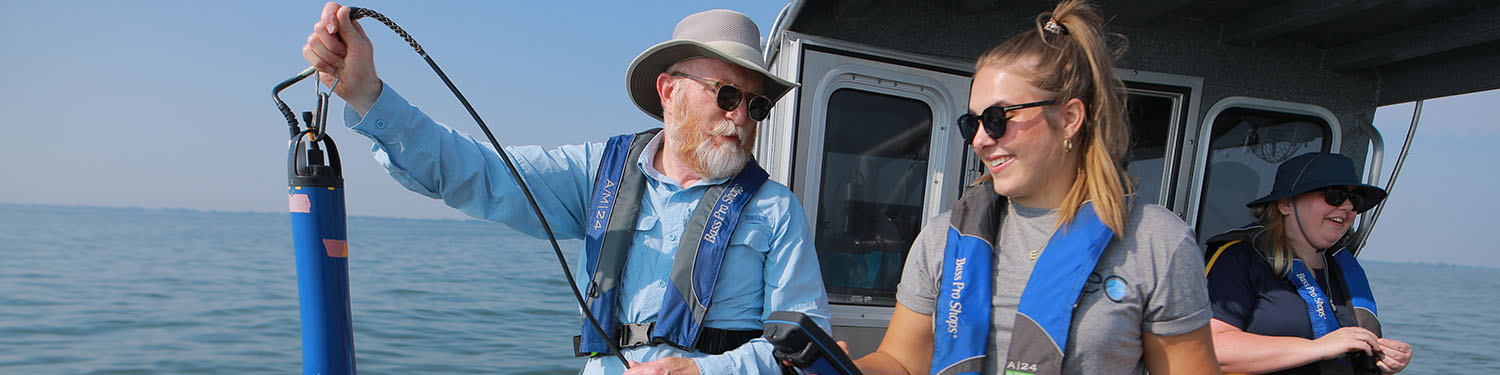
The University of Toledo brought together a team of scientists, engineers, doctors and public health experts in the immediate wake of the water crisis. Today this Water Task Force remains at the forefront of efforts to monitor water quality and predict blooms, remove toxins from water, understand health effects of exposure and prevent harmful algal blooms from forming altogether through policy and land management.

Monitoring Microcystins: UToledo Advances Technology to Track, Predict Harmful Algal Blooms

Ten years after the water crisis, thanks in part to efforts to more effectively monitor water quality and accurately predict harmful algal blooms led by researchers at UToledo, locals can turn on their taps with confidence. Early detection of harmful algal blooms is critical to their management, allowing water treatment plant operators to adjust their techniques to remove the toxins that are released by blooms into the raw water supply.
Optimizing Treatment: UToledo Lends Expertise, Data Analysis to Regional Water Utilities
The water crisis catalyzed a collaboration between UToledo and the Toledo Water Treatment Plant. Supported by the U.S. Army Corps of Engineers, U.S. Environmental Protection Agency, National Science Foundation, Ohio Water Development Authority and the Ohio Department of Higher Education through its Harmful Algal Bloom Research Initiative, UToledo water quality researchers have since expanded their footprint to Celina, Bowling Green, Defiance and Oregon.

Protecting Health: UToledo Leads Charge to Understand Health Effects of Harmful Algal Blooms

UToledo researchers have played a leading role in studying how harmful algal toxins affect the lungs, liver and gut. Now they’re taking that research out of the lab and into the community with a first-of-its-kind study that will follow 200 individuals over the next five years to better categorize the health risks of those who spend significant time near Lake Erie.
Seeking Solutions: UToledo Explores Policy, Land Management to Prevent Harmful Algal Blooms
UToledo experts draw on areas of expertise that range from remote sensing technologies to the environmental applications of geophysics to advance land management strategies to prevent harmful algal blooms. Meanwhile the College of Law’s Legal Institute of the Great Lakes has long supported discussions of the policies surrounding harmful algal bloom mitigation, among issues of importance to the Great Lakes.
