


Public Programs
Public programs are offered on Friday evenings throughout the year at 7:30 pm (May through September at 8:30 pm) and Saturday afternoons during the academic year at 1:00 pm. Admission to all public programs is $8 for adults and $6 for children, seniors and UToledo community members (children 3 and under are free).
We accept credit card and cash payments. All shows are first-come, first-served - reservations and advanced ticket purchases are not available. Doors open 30 minutes before the show, during which time you can explore the displays in our lobby. (Note the time change to 8:30 PM as of May 1.)
The planetarium (show) portion of the program is approximately one-hour, while the observing session on Friday night will continue until everyone has had a chance to take a look through the telescope. More information below.
Fall 2026 Schedule
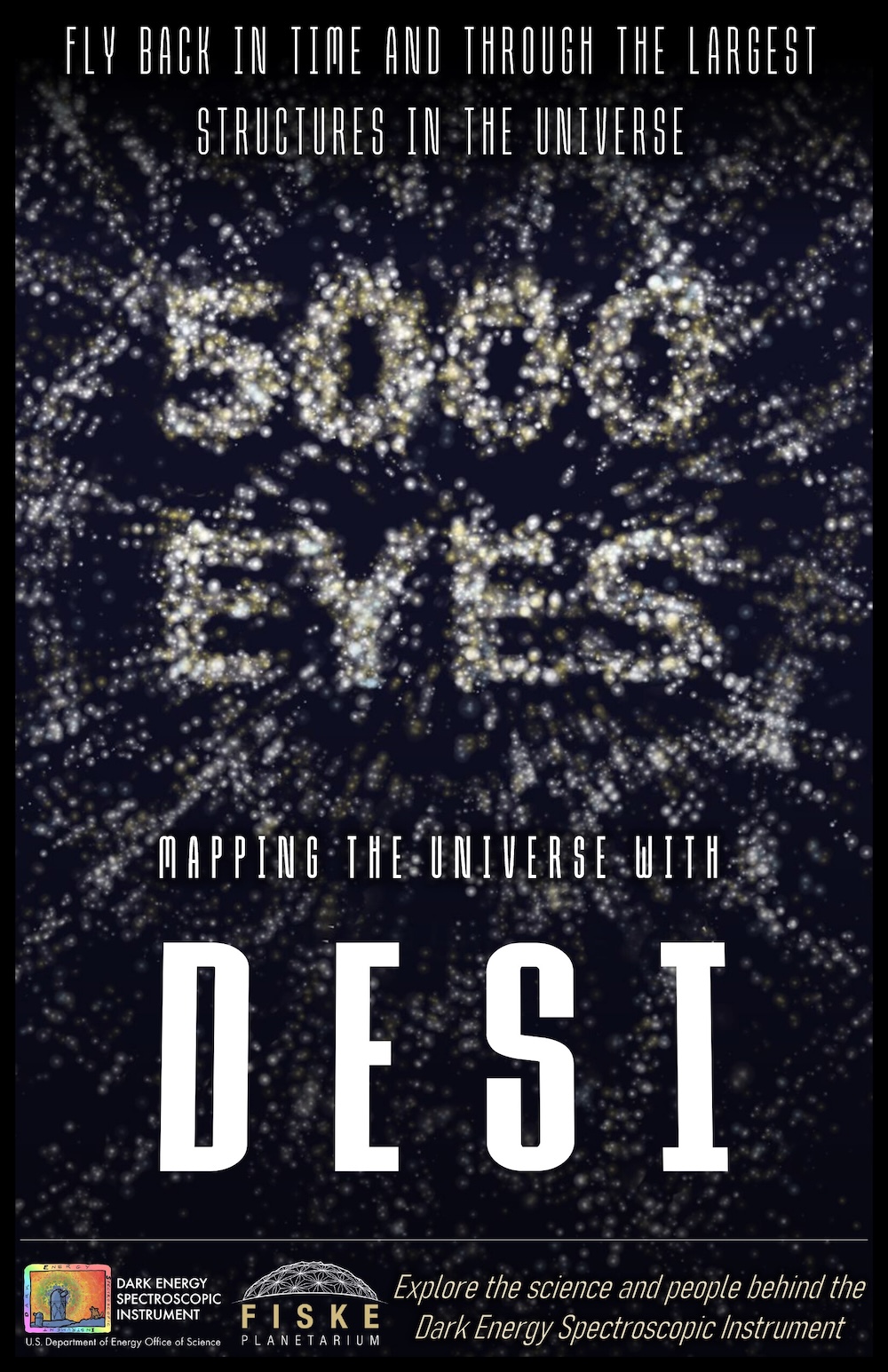
5000 Eyes: Mapping the Universe with DESI
Friday evenings at 7:30 PM in October
5000 Eyes: Mapping the Universe with DESI is a fulldome film about the Dark Energy Spectroscopic Instrument (DESI) which is creating the most detailed map of our nearby universe using a unique instrument which can measure the spectra of many galaxies at once. Experience the largest structures in the universe as never seen before by flying through a portion of DESI's initial data. Dive into modern cosmology, plus the scientific background and motivation for building a large map of galaxies. And, take a trip to Kitt Peak to see footage of the telescope in action while getting to know the amazing people from all over the world making this research possible.
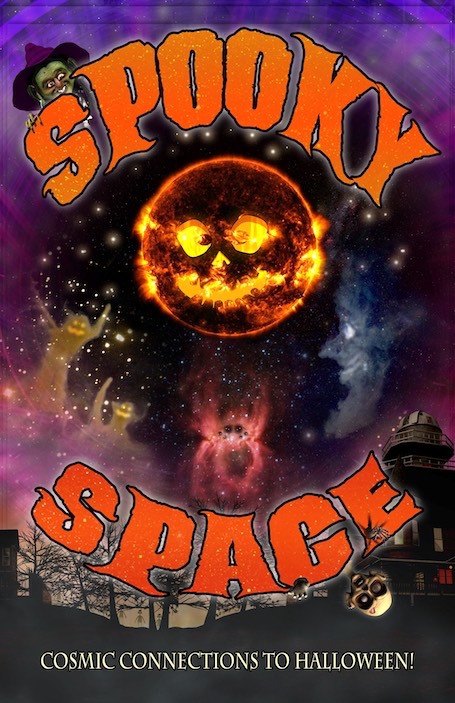
Spooky Space
Saturday afternoons at 1:00 PM in October
Explore the sky and outer space with a Halloween twist. Meet the space counterparts to spooky characters like ghosts, vampires, and witches. Spooky Space is a great Halloween show for ages 6 and up.
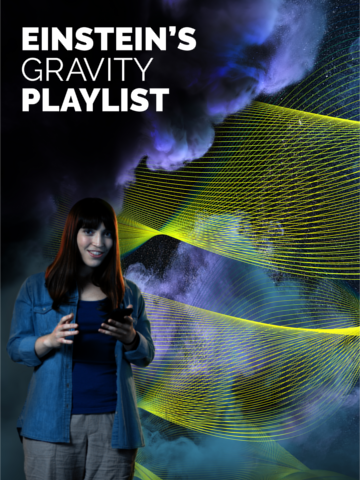
Einsteins's Gravity Playlist
Friday evenings at 7:30 PM, November 6 to November 20
Einstein’s Gravity Playlist explores the ripples in space-time known as gravitational waves. Albert Einstein predicted the existence of gravitational waves in 1916. A century later, scientists detected these waves using precise laser devices here on Earth. Join Lucia, a PhD student in physics, on an exploration of how gravitational waves are formed, how they move through the Universe, and how scientists like her work to hear them.

The Solar System Show
Saturday afternoons at 1:00 PM, November 7 to November 21
Looking to explore way-out worlds? Then join our kid crew reporters and rambunctious planets for The Solar System Show! The Solar System Show is hosted by kids who do all the science reporting and narration. The program includes a toilet paper solar system and the cow that landed on the Moon. It’s out there… enjoy!

Santa's Secret Star
Friday evenings at 7:30 PM, November 27 to December 18
Saturday afternoons at 1:00 PM, November 28 to December 19
Santa’s Secret Star is an updated full-dome version of our classic children’s program by the same name. Follow along as Rudolph introduces Santa to his friends the constellations. Watch how the constellations help Santa and his crew make it back to the North Pole. Learn how you can navigate by the stars just like Santa.
What you can expect:
-
A live guided tour of the Toledo night sky
You will learn about the constellations visible from Toledo and any planets visible to the naked eye. We also typically discuss one "hot topic" in astronomy, such as the discovery of new planets around other stars, or the latest NASA discover on Mars.
-
The full-dome presentation
Whether we are traveling inside a black hole, taking a tour of the moon with Elmo, or learning about the skies over Toledo, you and your family will simply be amazed at the full-dome immersive show. -
An open-ended question and answer session
Our expert host will answer all of your astronomy questions, whether they pertain to the live tour of the night sky, the feature presentation, or any other astronomy question that you might have. -
Observing at Brooks/Ritter Observatory
You will be escorted over to Brooks Observatory atop McMaster Hall to view the stars and/or planets through our new 14 telescope. On the first Friday of every month, we instead observe with the Ritter 1m (40 in) telescope. This telescope is the largest active telescope east of the Mississippi and is still used by the astronomers at UToledo for their research. All observing is weather permitting!